

Introduction
Imagine flipping through your old Pokémon trading cards and suddenly finding a card so rare that it’s worth a small fortune. What was once traded on the schoolyard has evolved into a fiercely competitive collectors’ market. In recent years, the values of Pokémon cards have literally exploded – influencers like Logan Paul have fueled the hype even more by spending millions on individual cards. In this article, we take you on a journey through time and present the top 10 most valuable Pokémon cards of all time. Dive into the stories behind these cards – maybe there’s a treasure hiding in your shoebox too!
The Top 10 Most Valuable Pokémon Cards of All Time
Rank 1: Pikachu Illustrator (CoroCoro Promo 1997) – 5,275,000 USD
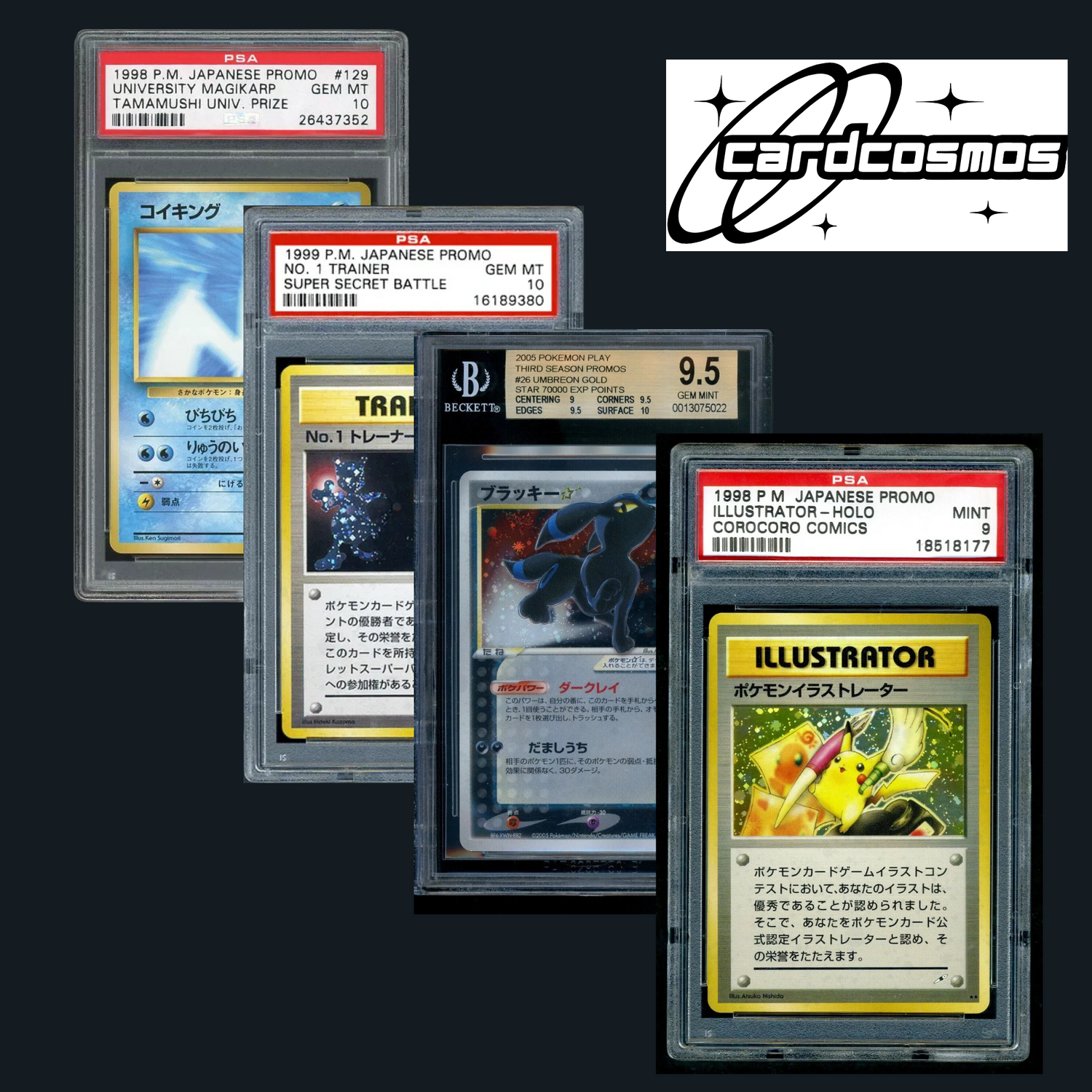
The undisputed throne is held by a card most can only dream of: the Pikachu Illustrator card. It is often called the “holy grail” of Pokémon card collecting – and rightly so. This card was awarded in late 1997 in Japan to the winners of a drawing contest held by CoroCoro Comics magazine. Children could submit their own Pokémon card designs, and the best illustrators received this special card as a prize, showing their Pikachu holding a fountain pen. Officially named “Pokémon Illustrator,” the card is commonly known by this name because Pikachu is featured on it. It is believed that a maximum of 39 copies exist, with about 20–24 cards known today. No other Pokémon card was produced in such a limited edition.
The value of this card breaks all boundaries. Already in 2019, before the big hype, one sold at auction for about 243,000 USD. During the Pokémon boom amid the pandemic, an Illustrator card in February 2021 fetched around 375,000 USD at PWCC. But then came February 2022: At a Goldin Auctions event, the price barrier was broken – a PSA 7-graded Pikachu Illustrator sold for 900,000 USD. It was the most expensive Pokémon card in the world at that time.
And yet, even this record was broken. YouTuber Logan Paul, a big Pokémon fan himself, wanted to own a PSA 10 copy (the only one in the world). In July 2021, he traded a PSA 9 Illustrator plus 4 million USD in cash – effectively valuing the PSA 10 card at 5.275 million USD. Guinness World Records confirmed this private deal as the most expensive sale of a Pokémon card ever. Logan Paul proudly showcased the card at WrestleMania, worn on a golden necklace, in front of millions. However, this purchase also sparked controversy: some collectors doubted whether the price truly reflected fair market value or if Paul deliberately inflated the value. The fact remains: no other piece of cardboard with Pikachu on it has ever come close to this sum.
The average sale value is hard to specify with so few sales – adding up known deals roughly results in an average of over 1 million USD, with an upward trend. But actually, every Pikachu Illustrator is unique, and the price ultimately depends on negotiations between the most hardcore collectors. Interestingly, Logan Paul announced in early 2025 that he plans to part with his copy. It will be exciting to see if a new buyer confirms or even surpasses the record price. The Pikachu Illustrator card remains the most expensive Pokémon card in the world – and its story, from the drawing contest in the 90s to the million-dollar deal in the social media age, is truly like a fairy tale for collectors.

Rank 2: Charizard 1st Edition (Base Set 1999) – 369,000 USD
No top list would be complete without Charizard (Glurak) – the flagship of all Pokémon cards. The holographic 1st Edition Charizard from the 1999 Base Set is probably the most famous collectible card ever. Many collectors today remember dreaming as kids of pulling this “fire-breathing dragon.” Well, that dream has turned into a nightmare for many wallets: a flawless copy of this card has become incredibly valuable. But how did that happen?
On one hand, Charizard is enormously popular as a Pokémon; on the other, the 1st Edition (with the “First Edition” stamp) was only available in the very first print run. Cards graded PSA 10 (perfect condition) are extremely rare – currently, there are about 120 such copies worldwide. In 2020, the Charizard hype peaked: American rapper Logic fulfilled a childhood dream by buying a PSA 10 Charizard in October 2020 for 220,000 USD. This purchase made headlines but was soon surpassed. On December 12, 2020, a bidder at a PWCC auction paid 350,100 USD for another Charizard in perfect condition. And as if that wasn’t enough, just hours later another copy sold – this time for the record price of 369,000 USD. Two record prices in one night – showing how crazy the market was playing.
This value of 369k remains the highest officially confirmed sale price for Charizard. On average, during the 2021 peak, several sales were recorded in the range of 200,000–300,000 USD. Nowadays, prices are more around ~200k or slightly below, as the supply (120 copies is relatively “a lot” for a top card) has somewhat saturated the collectors’ market. Still, Charizard remains the iconic most expensive Pokémon card in the regular set category. Any card found today in a child’s room in top condition could literally be worth a house. Incredible, isn’t it? Charizard’s popularity and nostalgia factor ensure this card will likely never lose its fascination – no matter if the price rises or falls.

Rank 3: Blastoise WotC Presentation Card (Prototype 1998) – 360,000 USD
Now it gets historical: in third place is a card that actually isn’t a regular card but a prototype never intended for sale. We’re talking about the Blastoise Presentation Card from 1998. Before the Pokémon Trading Card Game launched in the USA, the manufacturer Wizards of the Coast (WotC) wanted to demonstrate to Nintendo what the English cards might look like. So they printed some prototypes – including this Turtok (Blastoise) with a galaxy hologram and some design elements still missing. Some of these prototypes even had the back of a Magic: The Gathering card, as no final Pokémon back design was available. It is believed that only 2–4 of these Blastoise test prints exist.
This unfinished card has no English text but shows Blastoise’s image and layout as a sample. A few copies found their way into collectors’ hands years later and were long considered mythical. Only in 2021 was one of these holy grails professionally graded by CGC and offered at Heritage Auctions. The result: In January 2021, the Blastoise prototype fetched a price of 360,000 USD. At that time, it was the highest amount ever paid for a Pokémon card (later surpassed only by the Charizard hype and Pikachu Illustrator). This card is practically priceless due to its rarity – its value is best measured by the last record price paid. The story of how this card was created – as a demonstration item for Pokémon cards in toy stores to show “this is what the TCG should look like” – makes it a unique historical witness of Pokémon history. For collectors, Blastoise is thus a true treasure not only because of the high price but also because of its fascinating background.

Rank 4: Ishihara GX Promo (2017) – 247,230 USD
This card stands out from the list because it doesn’t show a Pokémon but a real person: Tsunekazu Ishihara, the president of the Pokémon Company. The Ishihara GX promo card was produced to celebrate Ishihara’s 60th birthday. It was never publicly available but a pure insider thank-you: at Ishihara’s private birthday party during the 2018 Pokémon World Championship in Nashville, it was distributed to staff and guests. Estimates suggest between 30 and 200 copies of this card exist – exact numbers are unknown, which adds to the myth.
The card’s artwork shows Ishihara in cartoon form with a Master Ball and his favorite Pokémon Snorlax (Relaxo) in the background (and his autograph if signed). The game stats are humorous – for example, the attack "60 Congratulations!" has no serious gameplay effect. Clearly, this card was meant to be a unique keepsake. Yet some copies found their way to collectors. In April 2020, the dealer Collectors Cache sold a PSA 10-graded Ishihara GX for 50,000 USD via eBay – already a record for such a new card. But it went even higher: In April 2021, another copy (signed by Ishihara, graded by PSA/DNA) was auctioned at Goldin Auctions for 247,230 USD. This price amazed the community and catapulted Ishihara GX among the most expensive cards of all time. Unsigned copies average about 30,000 USD, but a signed one in top grade has – as seen – fetched multiples of that. The story behind it makes this card so valuable: it’s a piece of Pokémon corporate culture in your hands, a symbol of the man who made Pokémon big. No wonder hardcore collectors are willing to pay dearly for it.
Rank 5: Kangaskhan Family Event Trophy Card (1998) – 150,000 USD
The Kangaskhan Family Event Trophy Card from 1998 in PSA 10 – awarded to parent-child teams who played Pokémon together. This card symbolizes family team spirit and is one of the rarest trophies in the Pokémon TCG.
Here comes a true family heirloom: the Kangaskhan promo from 1998, a trophy card only given to teams of parents and children playing together who succeeded in a tournament. This card was awarded at the so-called Family Event tournament in Japan. Only teams consisting of a child and a parent were eligible – a clever move by Pokémon to involve generations in the game. Only teams that made it into the top 8 of this parent-child tournament received the special Kangaskhan card as a prize. The holographic artwork fittingly shows Kangaskhan with its child in its pouch – perfectly matching the theme.
Since only a few dozen copies exist (estimates suggest ~40) and many owners have sentimental attachment, very few have reached the collectors’ market. In October 2020, two copies appeared in auctions – and both fetched a price of 150,000 USD. One of these sales was on eBay, where a PSA 10 Kangaskhan sold for 150,100 USD. Kangaskhan thus ranks among the most expensive Pokémon trophies ever. The current market value for top copies remains around 150,000 USD or higher. Fun fact: PSA has recorded only 12 cards graded 10 to date – the Kangaskhan trophy was not only rarely distributed but also hard to find in perfect condition. A beautiful story behind it and an impressive value – what more could you want?

Rank 6: Lugia 1st Edition (Neo Genesis, 2000) – 144,300 USD
Besides Pikachu, Charizard, and Mewtwo, there is another Pokémon that enjoys fan-favorite status: Lugia. The legendary Psychic/Flying Pokémon from the Johto region plays a big role not only in games and movies but also in the trading card game. The 1st Edition Lugia from the Neo Genesis set (English first print 2000) is considered Lugia’s first TCG card ever and has established itself as the most valuable card print of the second generation. Why? Two reasons: Lugia’s popularity and the extreme difficulty of finding a copy in top condition.
The Neo Genesis Lugia is notorious for even brand-new cards having small printing errors or scratches – so getting a PSA 10 in this set is extremely rare. Accordingly, prices soared during the Pokémon hype phase 2020/21. In November 2020, a collector paid a whopping 129,000 USD for a Lugia 1st Edition on eBay/PWCC. But it goes even higher: In May 2021, a Lugia graded Pristine 10 by BGS fetched a hefty 144,300 USD at auction. This sum temporarily made Lugia the most expensive non-trophy card outside the Base Sets. Prices have since calmed down somewhat – recent sales are more in the five-figure range (PSA 10 ~ 80,000 USD, PSA 9 significantly less). But on average, over the last 3 years, you can still expect about 100,000+ USD for a perfect Lugia. For many fans, this card is the “holy grail” of the Neo era – it combines nostalgia (Pokémon Silver, anyone?) with tough rarity.

Rank 7: Pokémon World Championships Promo No. 2 Trainer (2006) – 110,100 USD
In seventh place is a trophy card that jumps into modern times: the No. 2 Trainer card from the 2006 Pokémon World Championships. This card was given to winners (interestingly, it’s called "No. 2" but was awarded to first-place players) of the 2006 World Championships in Anaheim, USA. According to PSA, only three copies worldwide exist – one for each age division of the tournament. The card entitles the owner to participate in future World Championships, making it a dream come true for competitive players.
The value of this card comes from its low print run and the prestige of a World Championship winner’s prize. In February 2021, a sale of this rarity caused a stir: over 150 bids were placed at a PWCC auction until the price finally reached 110,100 USD. This was the highest amount ever achieved for a World Championship card at that time. Since so few exist, an average price is hardly reliable – the 110k basically reflects the market value. For collectors, this card is priceless because it tells the story of a world champion’s glorious achievement. You can imagine how proud the original winner was to receive this card – and how it has now become a sacred item in many collections.

Rank 8: No. 1 Trainer (Super Secret Battle, 1999) – 90,000 USD
This card reads like a ticket to a secret Pokémon tournament – and that’s exactly what it was. The No. 1 Trainer card (Super Secret Battle) was awarded in 1999 by the Pokémon Company at seven regional tournaments in Japan. Each regional winner received one of these cards, which in Japanese roughly says: “Congratulations – with this card you may participate in the secret final battle.” The card shows the silhouette of the legendary Mewtwo against a holographic background and was practically the entry ticket to a final tournament at an unknown location – a scenario like from the Pokémon movie! This mysterious aura makes the card extremely coveted among collectors.
Since only 7 copies exist, prices skyrocket on the rare occasions one appears. In July 2020, a No. 1 Trainer in flawless condition (allegedly PSA 10 Gem Mint) sold at auction for 90,000 USD. This sale set a record for Pokémon cards at the time and highlighted that trophy cards (i.e., tournament winner cards) form their own category of value increase. Average prices are hard to determine – such cards almost never change hands. However, one can assume that an excellent copy would fetch around 100,000 USD anytime it is offered. The anecdote behind it – a secret final round and a card as a golden ticket – makes the No. 1 Trainer a legend in Pokémon TCG history.

Rank 9: Umbreon Gold Star (Play Promo 2005) – 70,000 USD
Who would have thought that Umbreon (Nachtara), the dark evolution of Eevee, would one day be among the most expensive Pokémon cards? This Umbreon Gold Star card owes its value to a mix of popularity and extreme rarity. The card was awarded in 2005 as part of the Pokémon Players Club in Japan as a Play Promo. Only players who scored an incredible 70,000 points in the fourth season – meaning they succeeded in many tournaments – received this special holographic Umbreon card. Only a few dozen hardcore players achieved this, making the card rare from the start.
Additionally, Gold Star cards have a special feature: a small gold star next to the name, marking them as special collector variants. Umbreon is a very popular motif among fans, and current cards featuring Umbreon often fetch high prices even in modern sets. No wonder an original Umbreon Gold Star in top condition reaches astronomical sums. In June 2021, a copy graded BGS 9.5 (almost perfect) sold for 70,000 USD. Currently, prices for PSA 10 copies even exceed 100,000 USD – in early 2023, a PSA 10 copy sold for around 180,000 USD (a new record that almost influenced our list here). The average sale price recently was about 100–120,000 USD. This card impressively shows that modern Pokémon (from the 2000s) can now compete with vintage classics, as long as the circumstances of their distribution were so exclusive.

Rank 10: Tamamushi University Magikarp (1998) – 66,100 USD
Starting off the list is a card that shows even the most unassuming Pokémon can become a treasure. The Tamamushi University Magikarp promo card – better known in the West as the University Magikarp – was issued in 1998 by the Japanese Shogakukan magazine. To get this card, elementary school students had to participate in a special Pokémon contest: they solved tasks in the magazine and were invited to a tournament if successful. Anyone who won at least one battle there received this special Magikarp with holographic artwork as a reward.
Originally, up to 1,000 copies were printed, but far fewer actually circulated – many cards have been lost over the years. Collector value: Due to the low availability and unusual origin, this card is extremely sought after. One copy changed hands in February 2021 at an auction on the PWCC platform for 66,100 USD. Of course, only a top-condition copy (ideally PSA 10 Gem Mint) fetches such sums. The average market value in recent years has been around 65–70,000 USD – amazing for a Magikarp! The card symbolizes that even seemingly “worthless” Pokémon can reach unexpected values.

Conclusion: From Schoolyard to Collector’s Treasure
What used to be just a game has become a true passion for many – and for some even an investment. The incredible prices these Pokémon cards have achieved are more than just numbers: they tell stories of nostalgia, rarity, and pure collecting joy. Whether it’s the legendary Pikachu Illustrator or the highly coveted 1st Edition Charizard – each of these cards is a piece of Pokémon history.
And who knows? Maybe there’s still an undiscovered treasure in your old collection. Or maybe you want to lay the foundation for tomorrow today.
🎯 Tip for collectors & beginners:
Discover Pokémon displays and cards now at Cardcosmos – secure new sets, promo cards, and exclusive products for your collection. Maybe your personal treasure is already in the next Booster!






Leave a comment
This site is protected by hCaptcha and the hCaptcha Privacy Policy and Terms of Service apply.